
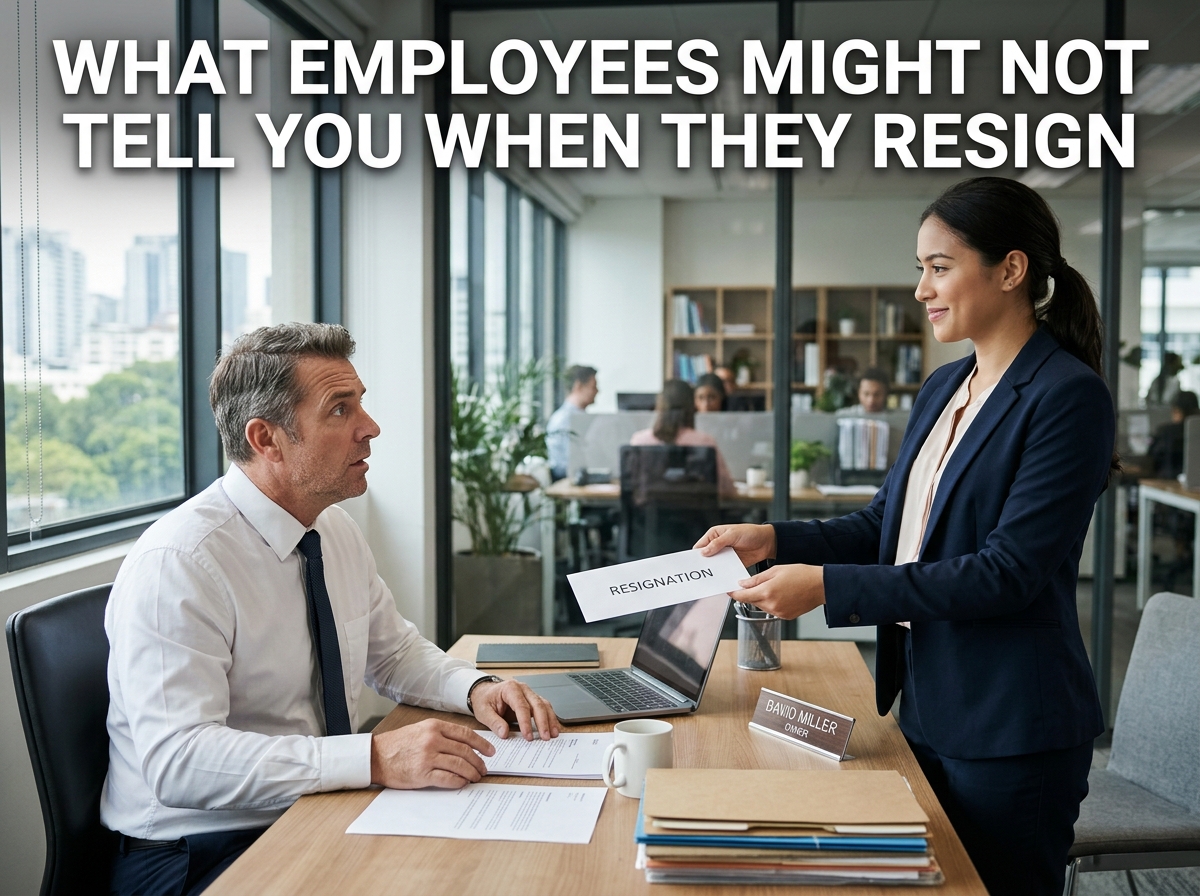
When Sarah walked into the owner’s office on a Tuesday morning, nobody expected what came next.
She had been with the company for six years.
She knew the clients by name. She trained new hires. She stayed late when deadlines were tight. If you asked anyone on the team who was most likely to be there five years from now, Sarah would have topped the list.
Then she handed in her resignation.
The owner was stunned.
“Why?” he asked.
Sarah smiled politely.
“I wasn’t looking to leave,” she replied. “A better opportunity just came up.”
The explanation seemed reasonable.
The new position offered a slightly higher salary. A shorter commute. Better benefits.
The owner thanked her for her service, wished her well, and immediately began planning for her replacement.
Case closed.
Or so he thought.
Over the next eighteen months, three more employees resigned.
Their explanations sounded remarkably similar.
A better opportunity.
A career move.
A change of direction.
Nothing unusual.
Nothing alarming.
Each departure was treated as an isolated event.
Each position was filled.
Each new employee was onboarded.
Yet the turnover continued.
Recruitment costs increased.
Workloads grew heavier for the remaining staff.
Morale began to decline.
Management couldn’t understand what was happening.
After all, employees kept saying the same thing:
“We found a better opportunity.”
Finally, the company engaged an external consultant to conduct confidential exit interviews with departing employees.
What emerged painted a very different picture.
Compensation was rarely the primary issue.
The real concerns were surprisingly consistent.
Employees felt their ideas were rarely considered.
Performance feedback was infrequent and unclear.
Career development discussions almost never occurred.
Several employees described communication gaps between departments.
Most revealing of all, many employees had reached the decision to leave months before submitting their resignation.
The “better opportunity” wasn’t the cause of the departure.
It was the catalyst.
The real reasons had been quietly accumulating beneath the surface for years.
This scenario plays out in organizations every day.
The stated reason for leaving is often only part of the story.
Employees rarely provide complete honesty during their final conversation with a manager, particularly when leadership practices, workplace culture, or internal relationships contributed to their decision.
Most people simply want to leave on good terms.
They don’t want conflict.
They don’t want awkward discussions.
And they certainly don’t want to spend their final days criticizing colleagues or supervisors.
As a result, organizations frequently hear the polite version of events rather than the complete one.
This is where exit interviews become invaluable.
When conducted properly and with assurances of confidentiality, they provide organizations with an opportunity to understand not only why employees are leaving, but also what might encourage future employees to stay.
The effectiveness of an exit interview depends largely on the questions being asked.
Closed questions tend to produce predictable responses.
Open-ended questions invite reflection and honesty.
Some of the most revealing questions include:
- What was the primary factor that influenced your decision to resign?
- At what point did you begin considering leaving the organization?
- Is there anything the organization could have done that might have convinced you to stay?
- What could your manager have done differently to improve your experience?
- If you were the CEO for one day, what is the first thing you would change?
These questions shift the conversation away from the resignation itself and toward the experiences that led to it.
The objective is not to assign blame.
The objective is to learn.
For small and medium-sized businesses, however, obtaining honest answers is not always easy.
In family-owned businesses and closely knit organizations, employees may hesitate to speak candidly about individuals who are closely connected to ownership or senior leadership.
Sometimes the very people contributing to turnover are highly trusted managers, long-standing supervisors, or even family members.
Employees know this.
As a result, they often remain silent.
Even when concerns are raised, leadership may unintentionally dismiss feedback involving people they know and trust.
This creates significant blind spots.
An independent third party can often uncover insights that internal stakeholders cannot. Departing employees are frequently more willing to speak openly with someone who has no involvement in organizational politics and no personal relationships to protect.
More importantly, an experienced advisor can separate isolated complaints from meaningful trends and help leadership identify opportunities for improvement before they become costly retention problems.
Sometimes the most valuable perspective comes from someone standing outside the picture frame.
Organizations often focus on replacing departing employees.
But replacing people without understanding why they left is like treating symptoms without diagnosing the illness.
The vacancy gets filled.
The training begins.
Operations continue.
Yet the underlying issue remains untouched.
Sooner or later, someone else encounters the same frustrations.
And the cycle repeats itself.
The costs extend far beyond recruitment expenses and onboarding time. Organizations lose institutional knowledge, productivity, morale, and, ultimately, the trust of their workforce.
By the time an exit interview takes place, it is usually too late to retain the departing employee.
It is not too late, however, to learn from them.
Every resignation tells a story.
Organizations that fail to listen hear only the ending. Organizations that conduct thoughtful, confidential exit interviews gain access to the chapters that came before.
Those chapters often reveal the real reasons people leave, the hidden challenges affecting the workforce, and the opportunities to create a workplace where talented employees choose to stay.
Most importantly, leaders must resist the temptation to overreact to a single comment.
One employee’s perspective may identify a personal concern.
Two or three employees reporting the same issue may reveal something much larger.
One opinion is feedback. Repeated feedback is a pattern.
The organizations that recognize those patterns and act on them are the ones most likely to improve retention, strengthen leadership, and build workplaces where people want to remain long after the next “better opportunity” comes along.
Your Turn
Have you ever uncovered a surprising insight during an exit interview?
Or have you ever left a job without sharing all the reasons behind your decision?
I’d love to hear your experiences and lessons learned. Share your thoughts in the comments below.
If you found this article valuable, please like, comment, and share it with your network to keep the conversation going.
#EmployeeRetention #TalentManagement #LeadershipDevelopment #WorkplaceCulture #HumanResources