
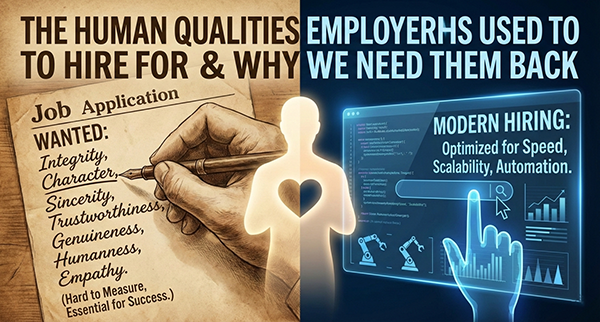
There was a time when job descriptions didn’t just describe what you’d do. They hinted at who you were expected to be. Words like integrity, character, sincerity, and trustworthiness weren’t always spelled out, but they hovered quietly behind phrases like “works well with others” or “takes ownership.” Somewhere along the way, as hiring became optimized for speed, scalability, and automation, those qualities slipped out of the checklist.
Not because they stopped mattering—but because they’re hard to measure.
Today, job ads are packed with competencies, tools, targets, and outputs. They rarely mention the inner qualities that actually determine whether teams function well, whether leaders are trusted, and whether organizations endure stress without breaking. Ironically, those invisible qualities are exactly what AI, automation, and robots will never fully replicate.
Consider character and integrity. They rarely show up in job descriptions anymore, yet they’re most visible when systems fail. Think of the employee who notices a billing error in the company’s favor and flags it anyway, knowing it may cost revenue in the short term. Or the manager who takes responsibility for a team failure instead of outsourcing blame downward. The counterexample is familiar, too: missed deadlines quietly reframed, problems buried until they explode, credit claimed quickly and fault assigned even faster. Skills didn’t cause those failures—character did.
Honesty and sincerity once anchored trust at work. You could take someone at their word. Feedback meant something. A “yes” wasn’t a placeholder, and a “no” didn’t come wrapped in corporate poetry. Today, honesty is often replaced with strategic ambiguity. You hear “let’s circle back” when the answer is no, or praise delivered publicly while concerns are aired privately. Over time, that gap erodes trust. Teams don’t just disengage from work; they disengage from each other.
Trustworthiness used to be assumed: if you were hired, you were trusted to act responsibly. Now, trust is often replaced with monitoring tools, excessive approvals, constant check-ins, and dashboards built to watch rather than empower. The paradox? Highly trustworthy people reduce the need for all of this. One dependable teammate can save a manager hours of oversight. One unreliable one can create systems, rules, and reporting layers that burden everyone.
Being genuine—showing up as a whole human rather than a carefully curated professional mask—once stabilized teams. Genuine people don’t spend energy posturing or protecting an image. They ask questions without pretending to know everything. They admit uncertainty early, before mistakes become expensive. The opposite shows up as performative competence: people who sound confident in meetings but quietly hope someone else catches the problem before it’s too late.
Humanness, though rarely named, mattered deeply. It showed up when someone noticed a colleague wasn’t themselves and checked in. When a leader adjusted expectations because life happened. When urgency didn’t erase dignity. Counterexamples are everywhere: burnout framed as resilience gaps, silence rewarded over dissent, and people treated as interchangeable resources. Cultures lose their humanity long before they lose profitability—but once they do, attrition, cynicism, and disengagement soon follow.
Empathy and emotional intelligence were once seen as leadership essentials, not “soft skills.” The ability to read a room, de-escalate tension, deliver difficult feedback without humiliation, and listen without defensiveness directly impacts outcomes. A technically brilliant manager with low emotional intelligence can dismantle a high-performing team in months. Meanwhile, a leader with moderate technical skills but high empathy often unlocks discretionary effort, loyalty, and innovation. AI can analyze sentiment. It cannot care. It cannot repair relational damage. It cannot sense when silence is carrying more information than words.
Community service and helping others used to signal something important: perspective. People who contributed beyond themselves often brought collaboration, humility, and long-term thinking into the workplace. They were less likely to hoard credit or step on others to get ahead. Today, these experiences are often dismissed as extracurricular. Yet the absence shows up in cultures where competition replaces cooperation and success becomes zero-sum.
These qualities: character, integrity, honesty, sincerity, trustworthiness, being genuine, humane, empathetic are not sentimental ideas. They are strategic assets.
As AI agents grow increasingly capable of executing tasks, generating content, analyzing data, and optimizing processes, technical competence will become table stakes. What will distinguish the modern workforce is not what humans can do, but how they choose to do it and who they are while doing it.
AI can be efficient, but it cannot be ethical. AI can be fast, but it cannot be accountable. AI can be scalable, but it cannot be trustworthy.
Only humans can carry moral judgment in ambiguity. Only humans can choose integrity over convenience, empathy over efficiency, and responsibility over deflection. Only humans can build trust that survives stress.
This is why these traits shouldn’t remain unspoken assumptions. They should be explicitly valued, described, and assessed in modern hiring not as vague “culture fit,” but as observable behaviors and expectations.
The future of work won’t belong solely to the most automated organizations. It will belong to those that intentionally cultivate what machines cannot replace: conscience, care, courage, and character.
If this resonated with you, I’d love to hear your perspective.
👍 Like if you believe human qualities deserve more space in hiring.
💬 Comment with a trait you think has disappeared and shouldn’t have.
🔁 Share to keep the conversation going, especially with leaders and recruiters shaping the workforce of tomorrow.
What do you think employers should start hiring for again?